Inside an Ant Colony: Queens, Workers, and Soldiers
Ant colonies are often described as superorganisms, where each individual functions as a specialized component of a larger, cohesive unit. This level of organization allows colonies to thrive in diverse environments, from tropical rainforests to arid deserts. Understanding the distinct roles within a colony, as well as the chemical communication system that binds them together, offers insight into one of nature’s most successful social structures.
At the heart of every colony lies a complex hierarchy defined by biological and behavioral specialization. The queen, workers, and soldiers each fulfill critical functions that contribute to the colony’s survival and growth. While the queen is primarily responsible for reproduction, workers manage foraging, brood care, and nest maintenance, while soldiers defend against threats. These roles are not arbitrary but are shaped by genetics, environmental conditions, and the colony’s developmental stage.
Chemical communication, primarily through pheromones, serves as the primary language of the colony. These chemical signals coordinate tasks, signal alarm, and even regulate the development of future generations. By exploring the interplay between caste roles and chemical signaling, we can better appreciate how ant colonies achieve their remarkable efficiency.
The Queen: Reproduction and Colony Foundation
The queen ant is the reproductive center of the colony. Her primary function is to lay eggs, which ensures the colony’s continuity. Depending on the species, a queen may live for several years, producing millions of offspring over her lifetime. She is typically larger than other colony members and possesses wing muscles that are often shed after the mating flight. Once she establishes a nest, the queen focuses entirely on reproduction, relying on the first generation of workers to feed and protect her.
The process of colony foundation begins when a newly mated queen lands and sheds her wings. She then digs a small chamber and begins laying eggs. Initially, she cares for the first brood herself, using stored fat reserves and metabolized wing muscles as sustenance. This stage is critical, as the queen must survive without external food until the first workers emerge. Once these workers mature, they take over foraging and nest expansion, allowing the queen to become the dedicated egg-layer. In some species, multiple queens may coexist in a single colony, a condition known as polygyny, which can enhance colony growth rates.
It is important to note that the queen’s reproductive output is influenced by factors such as food availability, temperature, and colony health. Environmental stressors can reduce egg-laying rates, and in some cases, workers may even replace a failing queen. These dynamics illustrate that the queen’s role, while central, is not absolute but rather part of a feedback system involving the entire colony.
Worker Ants: The Colony’s Backbone
Worker ants are the most numerous caste in any colony. They are sterile females that perform a wide range of tasks essential for daily functioning. Their duties include foraging for food, caring for the queen and brood, maintaining nest structure, and removing waste. Workers also play a crucial role in colony defense in species that lack specialized soldiers, using their mandibles and sometimes formic acid sprays to repel intruders.
Task allocation among workers is not random. It often depends on age, size, and physiological condition. Younger workers typically tend to the brood and queen inside the nest, while older workers engage in riskier tasks such as foraging and exploration. This pattern, known as age-based polyethism, reduces the colony’s exposure to danger because older individuals—who have already contributed to internal tasks—take on external risks. In some species, workers display morphological variations, such as larger head sizes for food processing or stronger legs for digging, further optimizing colony efficiency.
Worker ants also exhibit a remarkable ability to adjust their behavior in response to colony needs. For instance, if the colony loses a significant number of foragers, younger workers may accelerate their transition to foraging duties. This plasticity ensures that the colony can adapt to changing conditions without relying on a rigid hierarchy. Researchers at Insecta Insights have observed that such flexibility is a key factor in the ecological success of ant colonies across different habitats.
Soldier Ants: Defense and Specialization
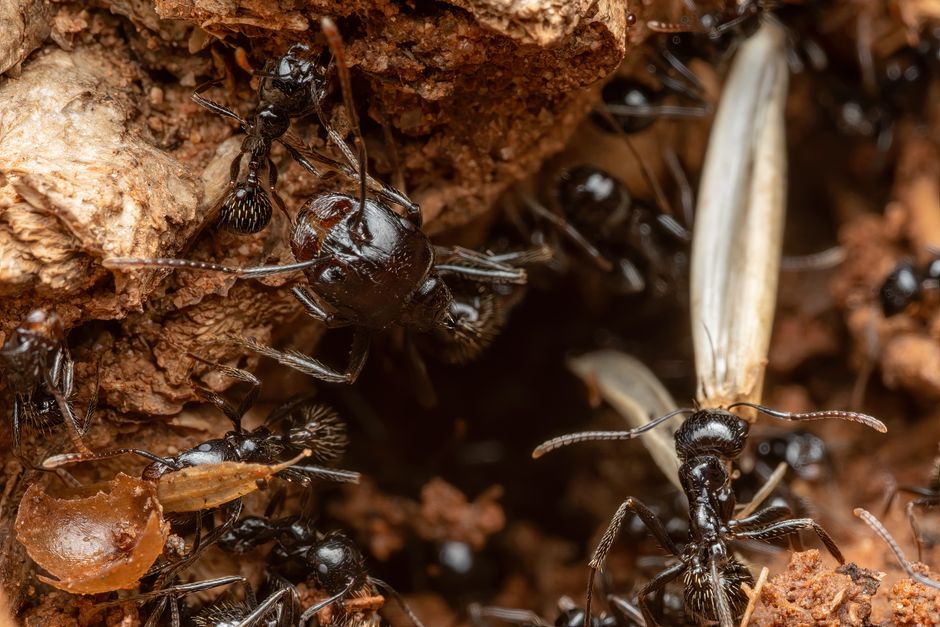
In many ant species, a distinct soldier caste has evolved to handle colony defense. Soldiers are typically larger than workers, with disproportionately large mandibles or heads that serve as effective weapons. Their primary role is to protect the colony from predators, rival ant colonies, and other threats. Soldiers often station themselves at nest entrances or along foraging trails, ready to intercept intruders.
The development of soldier ants is influenced by both genetic and environmental factors. In some species, larval nutrition determines whether an individual will become a worker or a soldier. A diet rich in certain proteins or the presence of specific pheromones can trigger the soldier developmental pathway. This conditional differentiation allows the colony to adjust its defense capabilities based on perceived threats. For example, when a colony faces frequent attacks, the proportion of soldier ants may increase in subsequent generations.
Soldiers are not solely defensive; they may also assist in breaking down food items that are too large for workers to handle or in clearing nest debris. However, their specialized morphology often limits their ability to perform other tasks. This trade-off illustrates the concept of division of labor, where specialization enhances overall colony efficiency but reduces individual versatility. The balance between soldier and worker numbers is maintained through subtle chemical signals that inform the colony’s overall caste composition.
Chemical Communication: The Language of Pheromones
Pheromones are the principal medium of communication in ant colonies. These chemical substances are secreted by various glands and elicit specific behavioral or physiological responses in other colony members. Each pheromone carries a distinct message, from marking foraging trails to signaling alarm or indicating the presence of a queen. The complexity of this chemical language allows ants to coordinate thousands of individuals without visual or auditory cues.
Trail pheromones, for instance, are deposited by foragers as they return to the nest with food. Other workers follow these chemical trails to the food source, reinforcing the trail as they travel. Over time, the most efficient routes become stronger as more ants use them. This collective decision-making process enables the colony to exploit resources quickly and adapt to changing food availability. Alarm pheromones, on the other hand, trigger aggressive behavior or evacuation, depending on the concentration and context. These signals are often species-specific, ensuring that only colony members respond appropriately.
Queen pheromones play a vital role in maintaining colony cohesion. They signal the queen’s presence and reproductive status, suppressing the development of ovaries in worker ants. If the queen dies or becomes infertile, the absence of these pheromones can lead to the emergence of reproductive workers or the initiation of a new queen. This chemical regulation ensures that reproduction remains centralized, preventing conflict within the colony. The study of ant pheromones continues to reveal how chemical signals can encode complex social information, a field that has applications in robotics and swarm intelligence.
Colony Organization and Division of Labor
The division of labor within an ant colony is not a static hierarchy but a dynamic system shaped by interactions among individuals. While castes provide a general framework, actual task allocation often relies on local information and feedback loops. For example, a worker may switch from brood care to foraging if it encounters a shortage of food or a surplus of hungry larvae. This distributed decision-making model allows the colony to respond to internal and external changes without centralized control.
Research into ant colony organization has revealed patterns similar to those observed in human economies, such as specialization and trade. Some species even exhibit a form of task partitioning, where a single task is broken into subtasks performed by different individuals. Leaf-cutter ants, for instance, have workers that cut leaves, others that transport them, and still others that process them into fungal gardens. Each step requires coordination, and interruptions in one stage can ripple through the entire colony.
The efficiency of this system is further enhanced by redundancy—multiple individuals capable of performing the same task. Redundancy ensures that the colony can continue functioning even if some members are lost. At the same time, too many individuals performing the same task can lead to inefficiency. Ant colonies manage this balance through simple rules, such as the threshold model, where an individual’s likelihood of performing a task increases when it perceives a greater need for that task. Understanding these principles helps researchers design algorithms for distributed systems and network optimization.
Ant colonies demonstrate how decentralized coordination can lead to complex, adaptive behaviors. By studying their chemical communication and flexible division of labor, we gain a deeper appreciation for the mechanisms that sustain one of nature’s most successful social structures.
In summary, ant colonies operate through a combination of specialized castes and chemical signaling. The queen ensures reproduction, workers manage daily tasks, and soldiers provide defense, all while pheromones orchestrate their interactions. This integrated system allows colonies to function with remarkable efficiency, adapting to challenges without the need for central planning. Observations from organizations like Insecta Insights continue to shed light on the subtle dynamics that make ant societies a model of collective intelligence.